
Honoring POWs and MIAs: Living the Code of Conduct
National POW/MIA Recognition Day – September 19, 2025
On September 19, 2025, the nation solemnly observes National POW/MIA Recognition Day, a time to honor the courage, tenacity, and sacrifice of those who were captured or never returned home. Central to this legacy is the U.S. Armed Forces Code of Conduct (COC)memorized by every cadet. More than 570 West Point graduates appear on our POW/MIA list. While we cannot feature them all, the stories that follow honor their collective courage, as reflected in the actions of these heroic graduates who embodied the Code of Conduct.
Those Who Never Returned [“I am an American, fighting in the forces which guard my country and our way of life. I am prepared to give my life in their defense.” -COC]
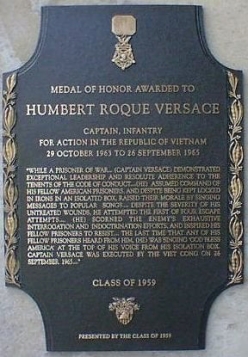
CPT Humbert “Rocky” Versace ’59, a Medal of Honor recipient, exemplified the Code of Conduct. Captured by the Viet Cong in October 1963 during an operation in the U Minh Forest, he resisted indoctrination and interrogation, assumed leadership among fellow POWs, and made three (some sources say four) escape attempts. He was isolated, shackled in irons for long periods, denied adequate food, yet he never capitulated. He was executed by his captors in September 1965, and his remains were never recovered.
Let us also remember other heroes whose steadfastness is less well known. On 18 September 1952, during the Battle of Outpost Kelly, 1LT William F. Nelson ’50 was involved in a night assault in which the outpost was attacked from multiple directions and, despite a valiant effort, was overrun. He was reported missing in action, believed by survivors to have been killed. CPT James Ruddell ’48, both POW and MIA, earned the Distinguished Service Cross for heroism. He was captured and forced on the brutal Tiger Death March to North Korea, and died in captivity. Pilot CPT James Van Fleet Jr. ’48 disappeared on April 4, 1952, while piloting a B-26 Invader on a night intruder mission over North Korea (near Haeju). His plane failed to return. None of these men’s remains were recovered. They are memorialized on the Courts of the Missing at the National Memorial Cemetery of the Pacific and at the National Korean War Veterans Memorial.
Those Who Endured and Survived [“If I am captured, I will continue to resist by all means available. I will make every effort to escape and aid others to escape.” -COC]
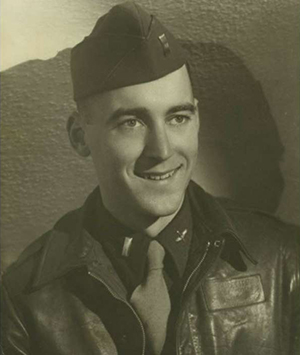
Others endured the torment of captivity and lived to share their stories, strengthening the nation’s understanding of resilience and duty. During WWII, when MG Rexford Dettre Jan ’43, piloting a P-38 Lightning, was forced to bail out over occupied Netherlands after mechanical failure. He touched down safely, was aided by civilians and escape networks, and evaded capture for over three months. Eventually captured, he made multiple escape attempts. Following one, he was removed from relatively safer POW camp conditions and endured harsh confinement (including time in a concentration‐camp environment). He survived captivity and returned to service in the U.S. Air Force. His legacy is honored through the West Point AOG Dettre Memorial Services Assistance Program, established in his name by his wife, to assist families of West Point graduates with burial services.
COL James “Nick” Rowe ’60 was one of the small number of American POWs who escaped captivity during the Vietnam War. After his five-plus years as a prisoner, he used his experience to help establish and formalize the U.S. Army’s SERE (Survival, Evasion, Resistance, and Escape) training course for those soldiers likely at risk of capture.
Those Who Maintained Morale [“If I become a prisoner of war, I will keep faith with my fellow prisoners… I will evade answering further questions to the utmost of my ability…I will never forget that I am an American, fighting for freedom…” –COC]
Robert C. Jones ’65 endured 1,882 days as a prisoner of war in North Vietnam (including time in the infamous “Hanoi Hilton”) after being shot down in January 1968. He survived brutal treatment, starvation, and abuse. Throughout his captivity, he maintained his duty, morale, and resolve and was released in March 1973 during Operation Homecoming.
For the missing who never came home and the POWs who bore the burden of war—we see you, we honor you, and we will never forget.
Code of Conduct
I am an American fighting in the forces that guard my country and our way of life,
I am prepared to give my life in their defense.
I will never surrender of my own free will. If in command, I will never surrender the
members of my command while they still have the means to resist.
If I am captured, I will continue to resist by all means available. I will make every
effort to escape and aid others to escape. I will accept neither parole nor special
favors from the enemy.
If I become a prisoner of war, I will keep faith with my fellow prisoners. I will give no
information nor take part in any action which might be harmful to my comrades.
If I am senior, I will take command. If not, I will obey the lawful orders of those
appointed over me and will back them up in every way.
Should I become a prisoner of war, I am required to give name, rank,
service number, and date of birth. I will evade answering further questions to the utmost of
my ability. I will make no oral or written statements disloyal to my country and its allies.
I will never forget that I am an American fighting for freedom, responsible for my actions,
and dedicated to the principles which made my country free.
I will trust in my God and in the United States of America.
See Also:
West Point Graduates Honored at 2024 Ceremony
West Point Graduate D-Day Heroes
The post Honoring POWs and MIAs: Living the Code of Conduct appeared first on West Point Association of Graduates.